


Travel tips
How to Stay Connected While Travelling: The Complete Guide
Everything you need to know about staying connected overseas. From travel eSIMs to data-saving tips, roaming alternatives, and multi-country connectivity.
Korea is wonderful year-round, and your experience changes with the seasons. The quick rundown is:
You’ll likely be arriving in Seoul, South Korea, via Incheon International Airport (ICN) or Gimpo International Airport (GMP). We won’t get into specifics about visas, as our readers come from around the world and requirements vary. If you are Australian like me, you do not need to apply for a visa for short stays (90 days); just complete the arrival card upon landing.
Once you exit the airport, your first stops should be withdrawing (or converting) cash, setting up your eSIM, and purchasing a T-money card (more on that shortly).
You’ll quickly discover that cash isn't widely used in much of Seoul. Still, on the flip side, small vendors, especially at markets and street food stalls, will only accept cash or payment methods that are not readily accessible to foreigners. For this reason, we recommend withdrawing a small amount of cash. The local currency in Korea is the South Korean won (KRW), and you can convert some at the airport or just withdraw from an ATM. Most ATMs will work with international cards. You'll also need cash to topup your T-Money card.
The T-money card is South Korea’s essential prepaid smart card for convenient travel on subways, buses, and taxis and can also be used for payments at convenience stores, vending machines and certain shops. This item is a must-have for all travellers and will make getting around Korea so easy. The caveat is that, at the time of writing, foreigners can only top up their T-money card with cash. So you’ll want to ensure you are carrying cash and keeping an eye on your T-money card balance. Topping can conveniently be done at any convenience store or ticketing machine (often within subway stations).
You’ll be able to purchase a T-money card at the airport as soon as you exit. You can also conveniently get on board the express airport train (more on that below) to save time.
Your first journey will be getting from the airport to your place of accommodation, and if you are staying near Seoul's central station, or a line that easily connects, then we always recommend the Airport Railroad Express (AREX). It’s a simple, comfortable and efficient way to get from the airport into the heart of Seoul. It is also relatively inexpensive, around $15 AUD or $9.00 USD. Reservations are required, but given the frequency of the trains, it rarely fills up, and you’ll be able to reserve at the airport station before you board the train.
Once you are out and about in Seoul, getting around is easy. Most major attractions are within walking distance to a subway station. You’ll also have the option for buses, which provide direct routes to many attractions and are convenient for shorter routes. Taxis are affordable in Seoul too and an easy way to get around, but to be honest, public transport is so efficient that you don’t really need to take a taxi. If you choose to use taxis, I suggest downloading the Kakao Taxi app to make booking easier.
Note: Google Maps does not work in South Korea. This caught me out on my first trip. I suggest downloading the Kakao Map app, which can be used for walking directions and public transport trips.
A lot of people will say you do not need an eSIM in a country like Korea because public Wi-Fi is widely available. But this is not entirely true. There are many parts of Seoul where you will not be able to access Wi-Fi, as well as rural tourist areas outside of the city. Of course, take advantage of Wi-Fi in your hotel and public spaces when possible to conserve data on your bundle, but you’ll be thankful for those times when you need direction, a translation or need to get in contact with someone and have your own eSIM to fall back on.
I always recommend that travellers purchase and install an eSIM before they leave their home country. This ensures you have a reliable connection to set everything up and allows you to troubleshoot. Pocket Roam offers several eSIM options for South Korea, including fixed data bundles, unlimited bundles, and regional packages if Korea is not your only destination.
You can explore our range of data bundles below.
If you are a seasoned traveller to Korea, then I am sure you already have preferences on locations and accommodation. But for those first-time explorers, I suggest staying in the Myeongdong region, which is considered a central location and the heart of Seoul for shopping, street food and K-beauty. It’s also very close to Seoul station, and getting around the city to explore is pretty easy.
One thing you will notice about Korea is that the accommodation is often quite dated, regardless of price. I prefer to stay in more modern hotels, and if I had to recommend one in Myeongdong, it would be the L7 Myeongdong by LOTTE. In all honesty, there is nothing inherently special about the rooms. But they are clean, modern and decently priced. I am always comfortable there.
Hongdae is also a popular area to stay, especially if you are looking for nightlife and cheap food. It’s a university area and frequents a much younger audience, resulting in a pretty vibrant nightlife, street art, cool shops and less traditional (but very cool) food options.
Finally, Gangnam is also a great area to stay, with a lot of K-pop culture and shopping. However, it’s much further from central Seoul and a lot of other historical or cultural sites in Seoul, meaning you will spend a lot of time travelling about.
Tteokbokki are a popular street snack that you will find everywhere in Seoul. These chewy, cylindrical rice cakes are simmered in a rich, spicy, and slightly sweet sauce. They are usually always spicy, so if you can’t handle chilli then it may be best to give these a miss.
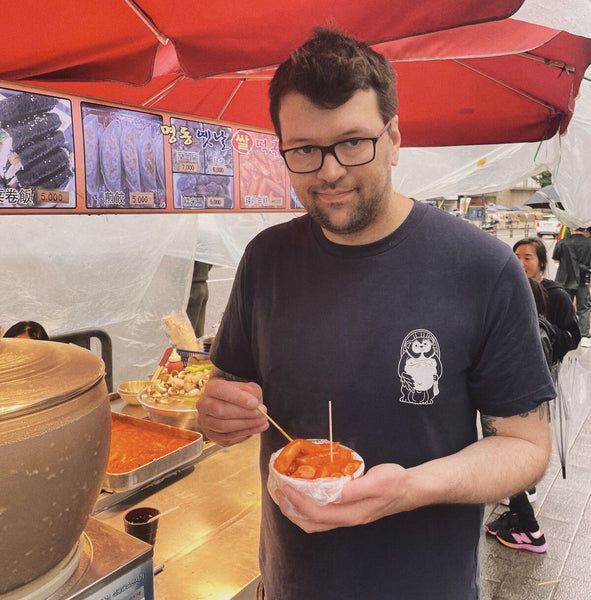
Enjoying a bowl of Tteokbokki in Myeongdong, Seoul.
Bibimbap is a staple food in Korea, and you will find it everywhere you go. It usually consists of a bowl of rice topped with an assortment of seasoned vegetables, meat (usually beef), a raw egg, and spicy gochujang sauce. The bowl will generally come with all the ingredients neatly separated, and you combine them all before consuming. Given the dish's popularity and availability everywhere you go, there are many variants, including non-spicy, vegetarian, vegan, etc., making this a dish that will cater to pretty much everyone.
This is a spicy Korean hot pot that blends Western military rations, like Spam, with traditional Korean ingredients like kimchi and gochujang, and instant ramen noodles. It is an absolute must-have!
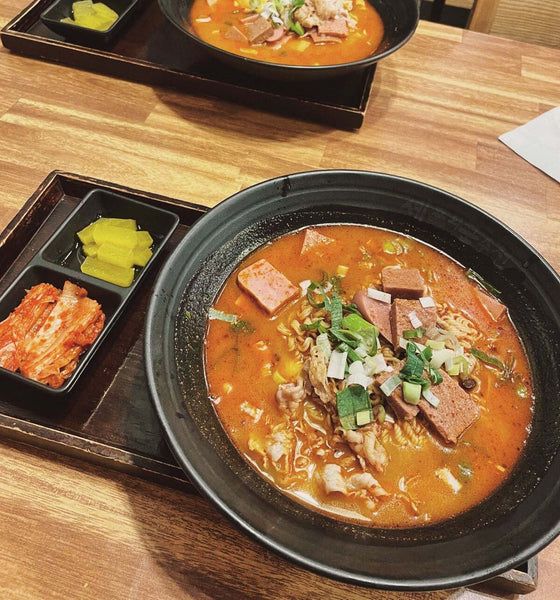
Korean army stew with spam and fish cakes.
Dak Galbi is a popular South Korean dish made by stir-frying marinated diced chicken in a gochujang-based sauce with sweet potatoes, cabbage, perilla leaves and tteok (rice cakes). It’s generally cooked on the table, on a large hot plate and shared among everyone. My favourite way to eat Dak Galbi is covering it in cheese.
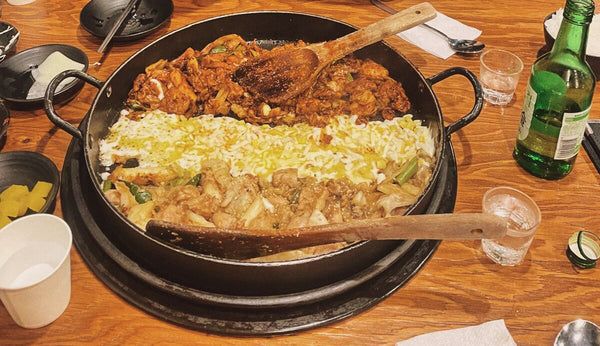
Dak Galbi with cheese and two types of chicken.
There is no shortage of things to do and see in Seoul, but if you get time, I recommend the following activities as absolutely worthwhile.
Bukhansan National Park in Seoul offers some of the best hiking trails in Korea, and actually holds the Guinness World Record for Most Visited National Park (per unit area). There are suitable walking trails for both beginners and experienced hikers, and the park is very accessible from Seoul. I recommend you check it out, if just to take a break from the noise and neon lights of Seoul.
There are several ways to access the park, but one of the easiest is through the. To get there, we just jumped on a train to Bukhansan Bogungmun station, from there you can catch a bus (only a few minutes), or walk to the entrance of the park. The walk is about 15-20 minutes, and you will pass a 7-11 near the station if you need some last-minute supplies. The initial walk itself is enjoyable, and I recommend this. You can walk down off the main road and follow the riverside all the way to the Jeongneung Park Information Centre where you will find the entrance to the park.
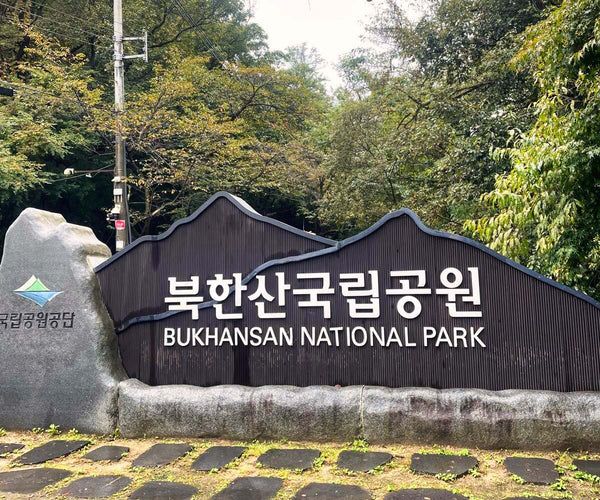
Entrance to the national park near Jeongneung Park Information Centre
There are various walking tracks, for all levels of hikers, and if hiking isn’t really your thing, I suggest still trying to get as far as the Daenammun Gate, which is part of a 10km defensive wall and old fortress. Unfortunately, it was a wet and foggy day on our trip, and although we did climb to Baegundae Peak, we didn’t have any view of the city due to the fog. The hike was still worthwhile and a great experience.
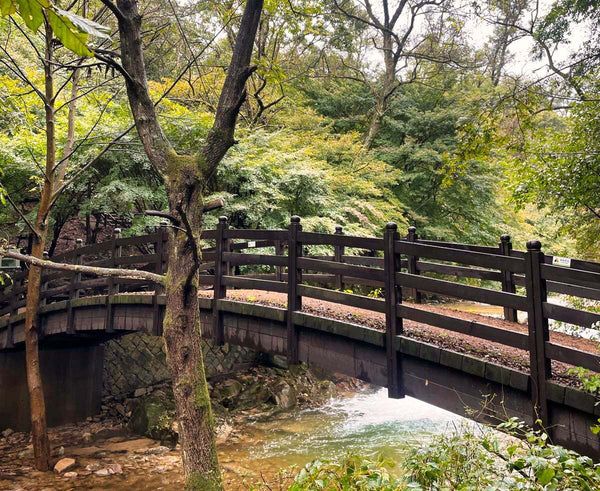
Wooden bridge over a stream in the Bukhansan National Park.
Gyeongbokgung, the former royal palace of the Joseon dynasty, is a must-see while in Seoul. It features the traditional palace, serene gardens, and several museums (including the National Palace and the Folk Museum). The gardens are lovely to stroll around and look amazing in all 4 seasons, though they can get pretty busy. We visited during the Chuseok mid-autumn festival, so it was packed.
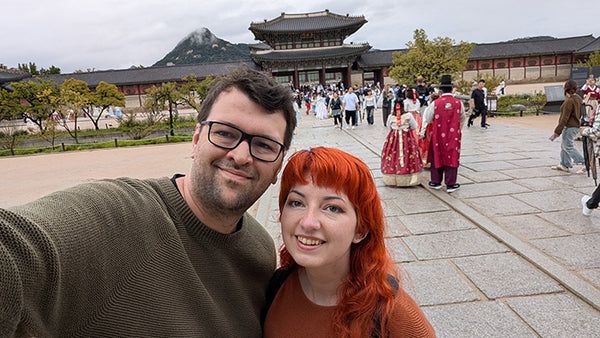
Us taking a selfie in the Gyeongbokgung courtyard.
You’ll see many people dressed in Hanbok, traditional Korean clothing. Foreigners are also welcome to dress up, and you’ll actually be given free entry to the palace if you are dressed in Hanbok (this is true for all royal palaces in Seoul).
One of the main highlights of the palace is the Royal Guard Changing Ceremony, a re-enactment of the Joseon Dynasty's changing of the royal guard. They perform this twice a day, and it does get very crowded, so I suggest getting there a little earlier and securing yourself a good viewing point within the courtyard (you’ll see where they section off space for the ceremony).
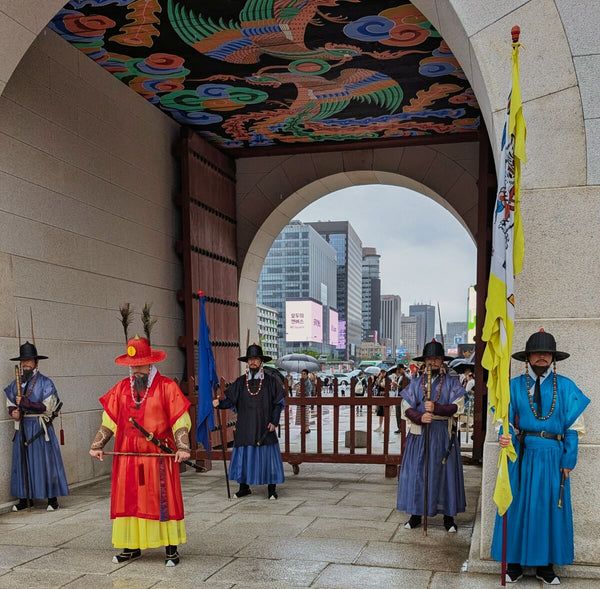
Traditionally dressed royal guards in front of the Gyeonbokgung gate.
That concludes part 1 of my Korea tips travel blog. The next part will give you some advice on getting to Busan via high-speed rail and some of the great things to see (and eat) in South Korea’s second-largest city.
If you are heading over to Korea soon, don’t forget to check out our eSIM data bundles for the best offers.
Everything you need to know about staying connected overseas. From travel eSIMs to data-saving tips, roaming alternatives, and multi-country connectivity.

For travellers planning a trip between March and May, here’s what to expect in Bali, where to go, and how to make the most of your time on the island.

For travellers planning a trip in Spring, here is what to expect across Vietnam, where to go, and how to make the most of your time in this beautiful country.
Sign up to our mailing list and you (probably) won’t be disappointed.
You’re in! Keep an eye on your inbox.
Something went wrong and your sign-up was not sent. Please try again.